
Customer Due Diligence
Digitizing the ‘Know Your Customer’ Form
Overview
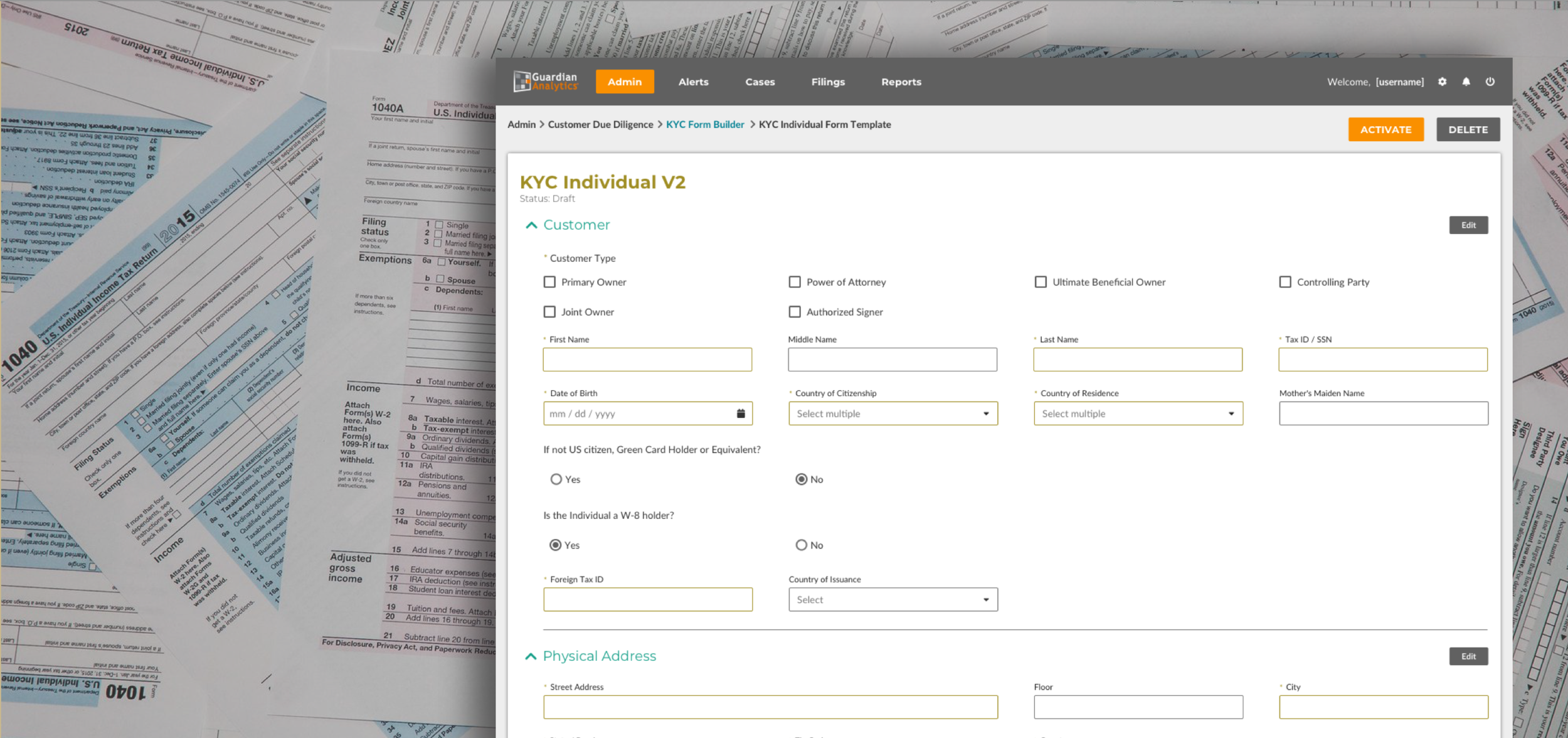
Nice Actimize provides solutions which help Financial institutions fight financial crime using behavioral analytics and machine learning. Their prime platforms are Fraud Detection and Evidence Lake Anti-Money Laundering (AML) solutions, designed for Financial Institutions like banks and credit unions.
Goal
Simplify and improve the customer on-boarding experience for Financial institutions by building a digital version of the ‘Know Your Customer’ KYC form in the Evidence Lake AML Platform and automatically calculating the risk score based on the answers.
With this, bankers can quickly fill out details about the customer every time a new customer wants on onboard with the financial institution. Based in the responses to the questions in the form, a risk score is computed, using which the FI can efficiently assess if the customer is risky and whether they should onboard the customer.
My Role UX Designer
Skills User Research, Personas, Scenarios, Task Flows, Wireframes, Information Architecture, UI Prototype,
Duration 4 2-week sprints
Tools Sketch, Invision
Context
Customer Due Diligence (CDD) is one of the key pillars of any AML platform. Financial Institutions (FI) need to establish that their customers are who they say they are and have been transparent about their business. The ‘Know Your Customer’ or KYC form is one of the first steps in achieving CDD.
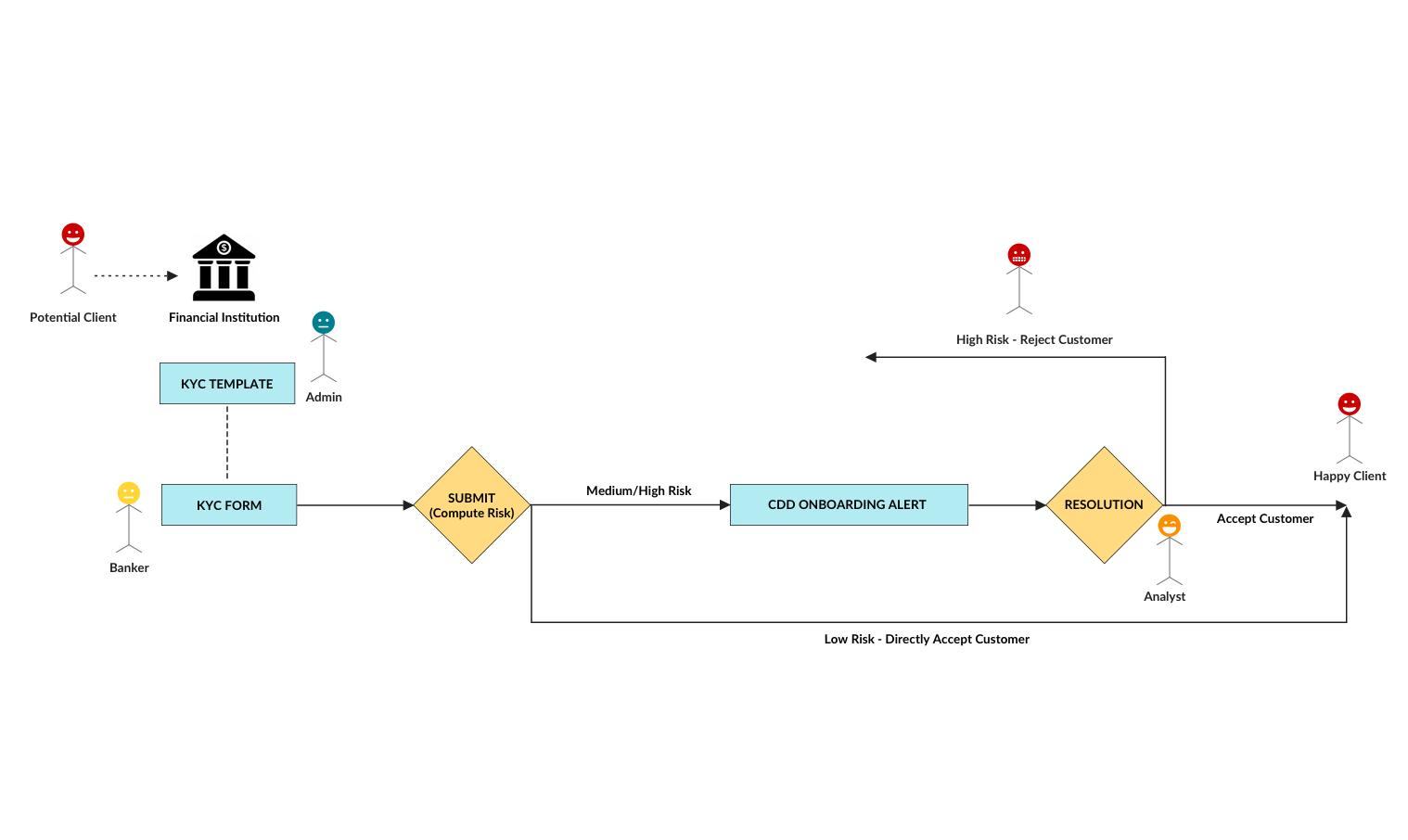
Every time an individual or business wants to open an account at a Financial Institution (FI), the banker at the FI, must fill out a KYC form. The KYC form contains important questions about the Individual or Business, their transaction details, source of funds etc. Once this form is filled out and submitted, based on the responses to these questions, a risk score is computed for this subject. If the risk score is low, the subject is immediately on-boarded. Where as if the risk score is medium or high, a CDD on-boarding alert is generated. A risk analyst then reviews the alert, performs his investigation on the subject and then decides to on-board reject the subject.
Emphathize
Our Customers
The banking industry is very traditional. Many banks still use paper-based KYC forms and manually assess whether to onboard a subject of not. Some banks have in house solutions that are completely customized to their needs. Some of the competitive solutions that are offered are mostly on-premises and tend to be expensive. Each Financial Institution is very unique based on the size, location and the audience they want to cater to. They have to conform to numerous Financial Regulators and ensure that they are compliant with everything. Besides, due to the nature of the industry, they need to reply on the core banking platforms for transaction data.
User Research
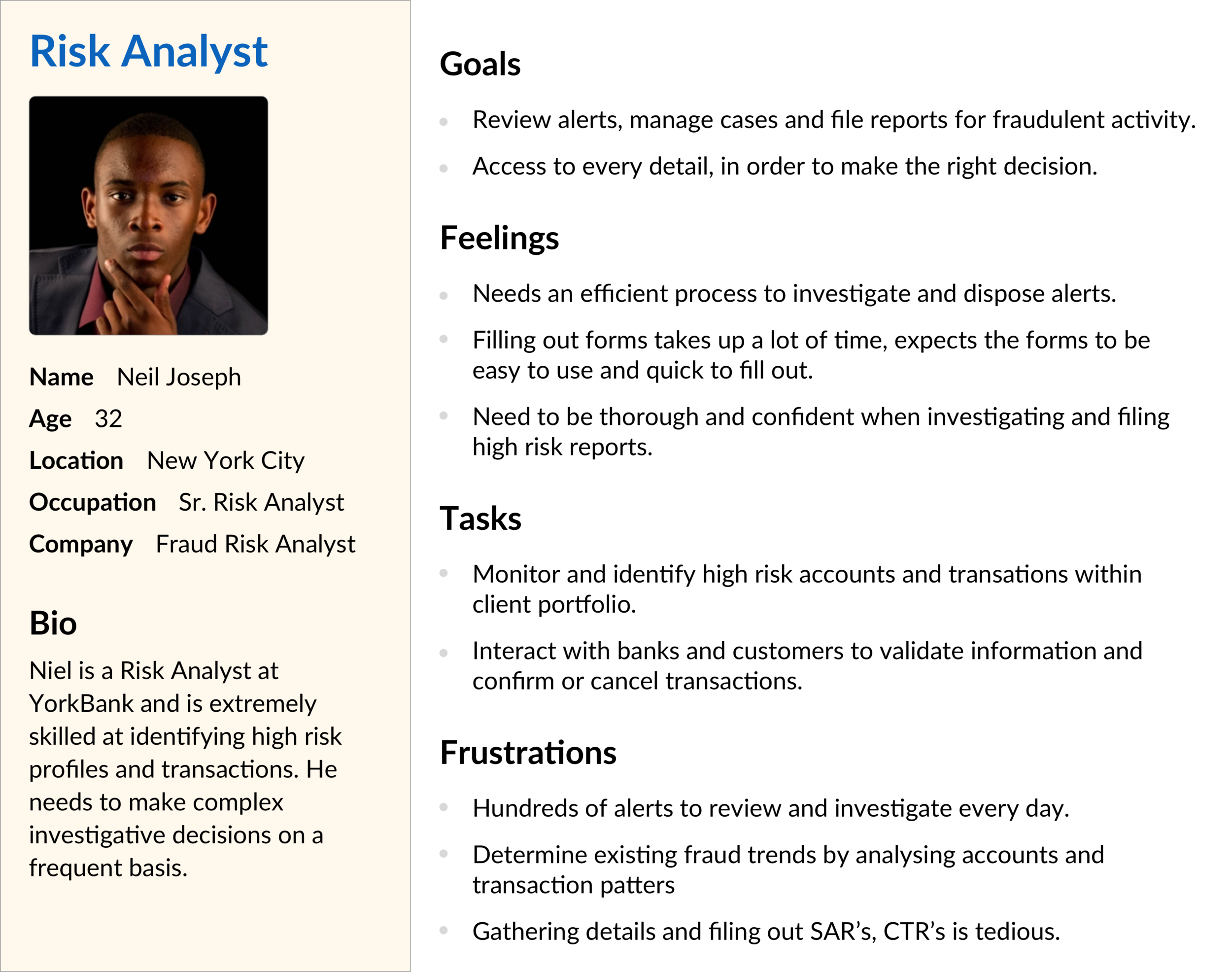
We talked to a lot of different FI’s to understand their needs and goals for CDD and especially the KYC form. Depending on how they interact with our application, we’re created different persona’s.
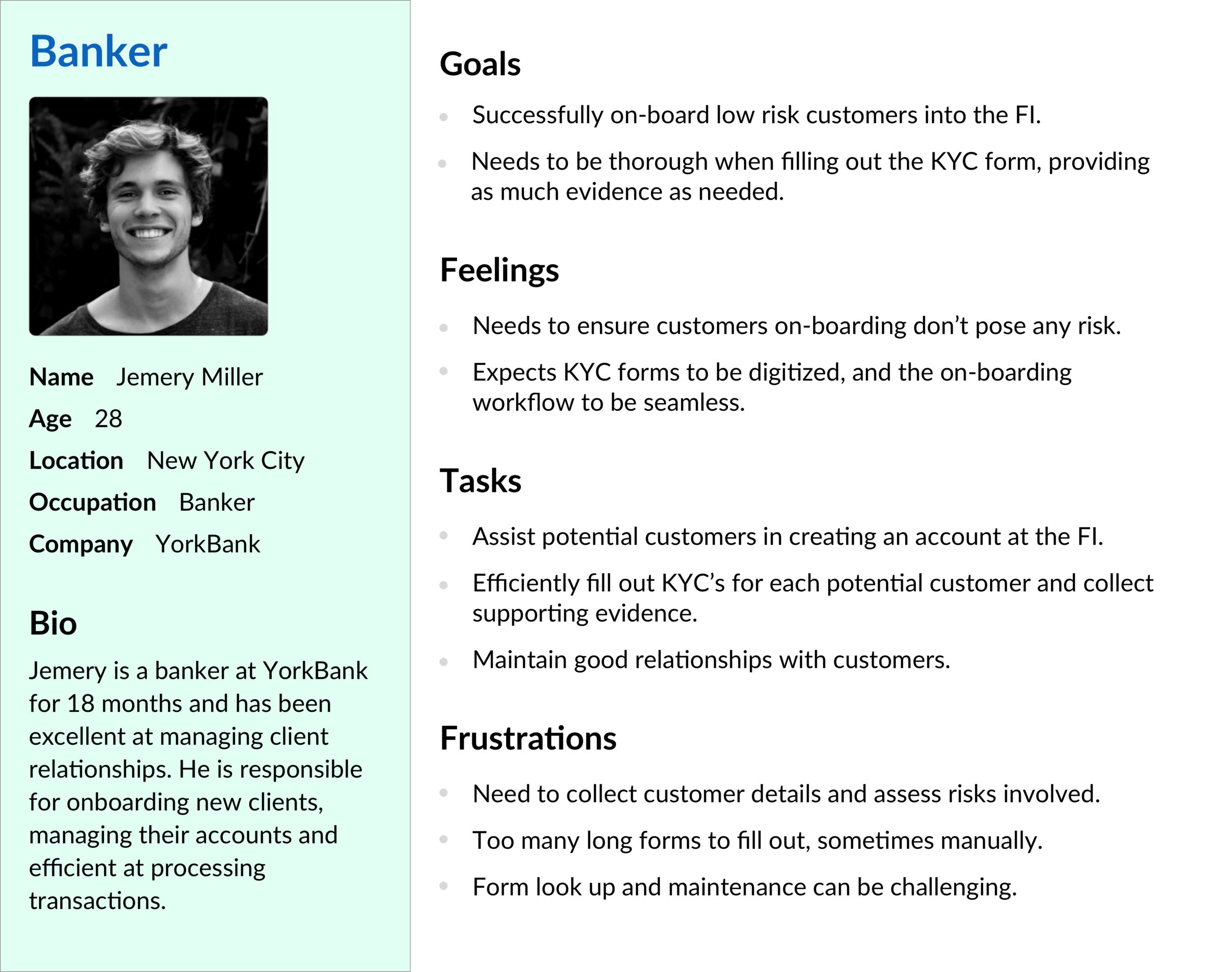
Banker
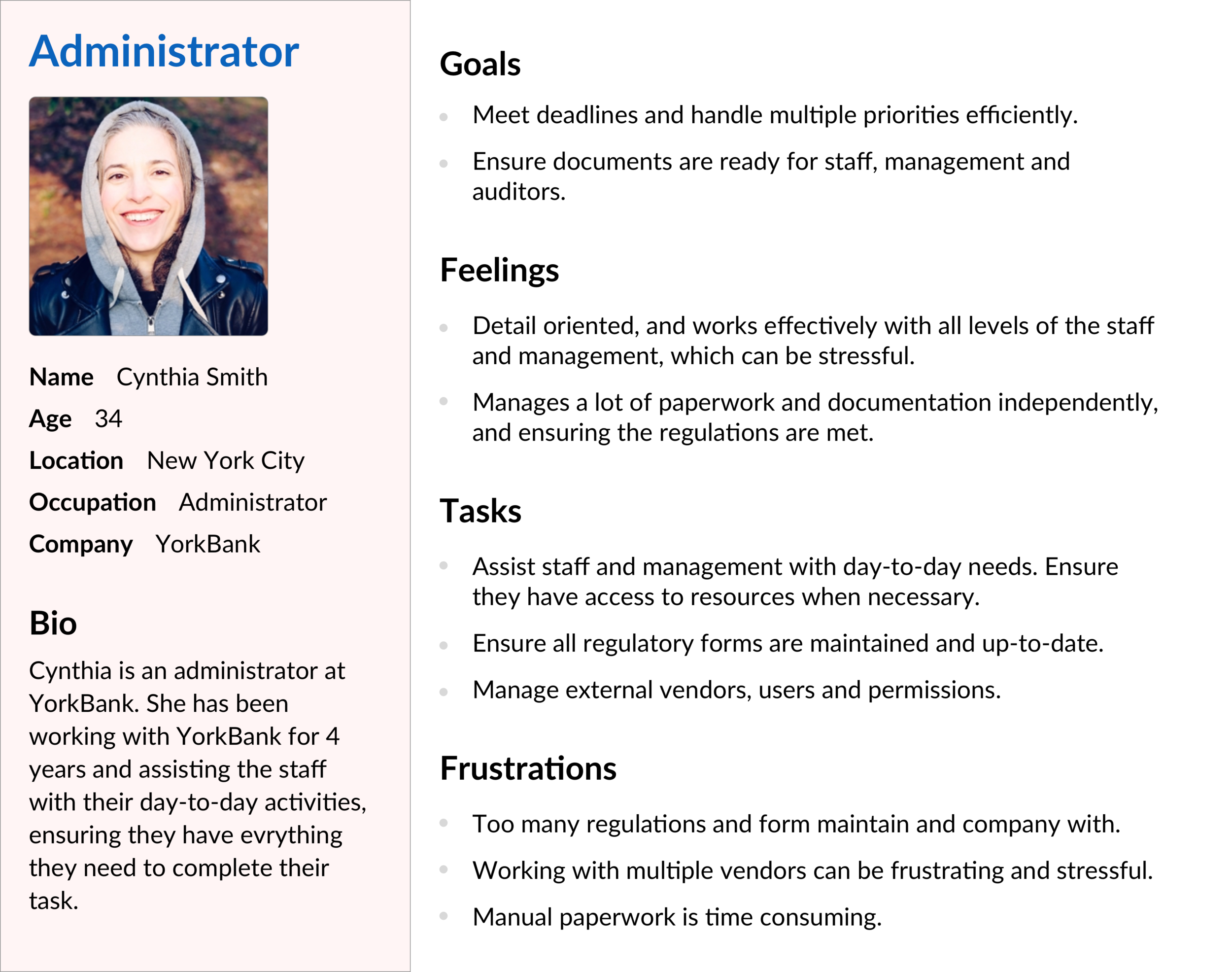
Admin
Analyst
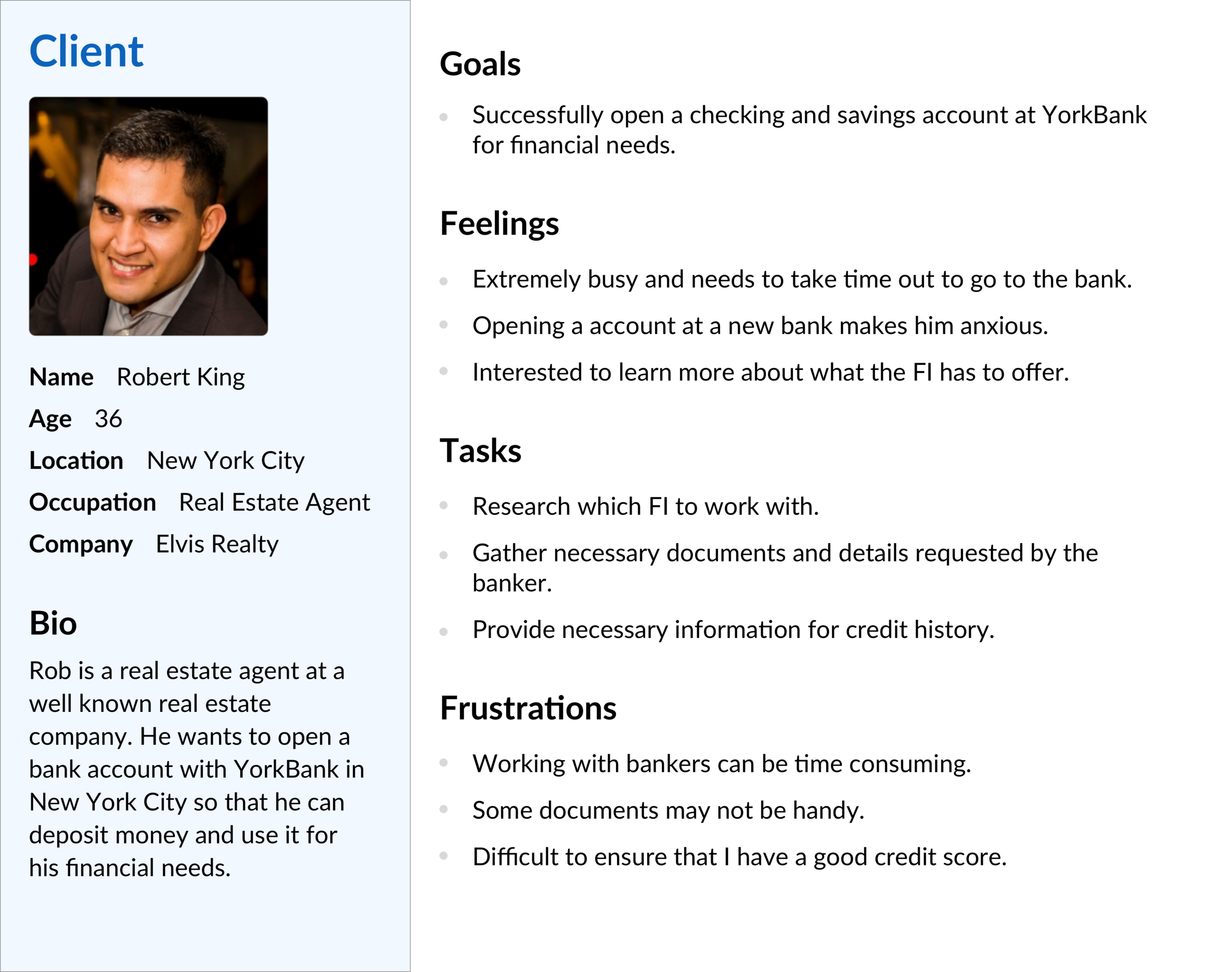
Client
We interviewed 3-5 users for each role and discussed their process, their challenges and their work-arounds. The following charts provide a summary of the key challenges for each persona.
Define
Problem statement and Idea generation
After the research phase, we analyzed the data from the interviews and found common themes with helped clearly define the problem and goals.
Manual KYC Form: The common theme that we identified among the bankers was that the KYC forms are long and consume a lot of time to fill it out. It is however a legal requirement that every FI has to comply with the AML laws. Most smaller banks manually filled out the paper based KYC forms by asking their customers the questions, and then reported their answers to calculate the risk.
Idea: Design a digital form that would help reduce the time to fill up and provide an automated way to compute the risk the client poses.
Updating the KYC Questions: The AML regulations keep changing and the FI’s need to update their questions accordingly. Relying on external vendors to update the KYC could take months, and is very expensive.
Idea: Design a configurable KYC form template, where Admin’s have the option to configure the KYC forms for their FI independently, there by minimizing the time is takes to meet the legal requirements.
Computing the risk for each client: Depending on the responses to the questions in the KYC form, the analyst needs to assess the risk and evaluate whether to on-board the customer or not.
Idea: Automated risk scoring would drastically simplify the complexity involved. If a customer’s risk score is low, they can be immediately on-boarded. Where as if a customer risk score is is medium or high, an alert would be generated, and the analyst can review the risk factors and decide whether to on-board this customer or not.
Ideate
After understanding the challenges faced by the customer, we spent time brainstorming how to address them.
Option 1: Provide a digitized KYC form for with automated risk scoring.
Option 2: Provide a configurable KYC form template, based on which they can generate KYC form and support automated risk scoring.
Providing a customizable KYC form was key, and this required us to design a ‘KYC Form Template Builder’ which would help created a KYC form template for different types of customers. The Admin would configure these templates with the correct set of questions for each customer group.
The bankers would then create a new KYC form based on this template for every new customer.
High level workflow
Deeper understanding of the goals
KYC Form Template for Admins
Admins want an easy way to add, edit and remove questions in the template.
Admins want to the flexibility to configure different types of questions.
Admins want to configure how the answers to these questions are risk scored.
Admins need to maintain different templates for different customer types.
Legal requirement: Every change needs to be audited, nothing can be deleted. Use versioning for easy maintenance.
KYC Form based on the Template for Bankers
Bankers want to quickly create new KYC form based on the customer type and KYC template.
Bankers want to efficiently update KYC forms every year for existing customers. Use versioning for easy form lookup and maintenance.
Bankers want to onboard low risk customers immediately.
Processing high risk customers alerts for Analysts
Analysts only review medium or high risk customers alerts based on the risk score of their KYC form.
Analysts want to view all the responses, customer information and investigate if it’s safe to onboard the customer or not.
Prototype
I used the InvisionApp to create low fidelity wireframes.
This process helped brainstorm ideas and go through the flow with the product team. We though about ways to improve it and iterated on the design and flow.
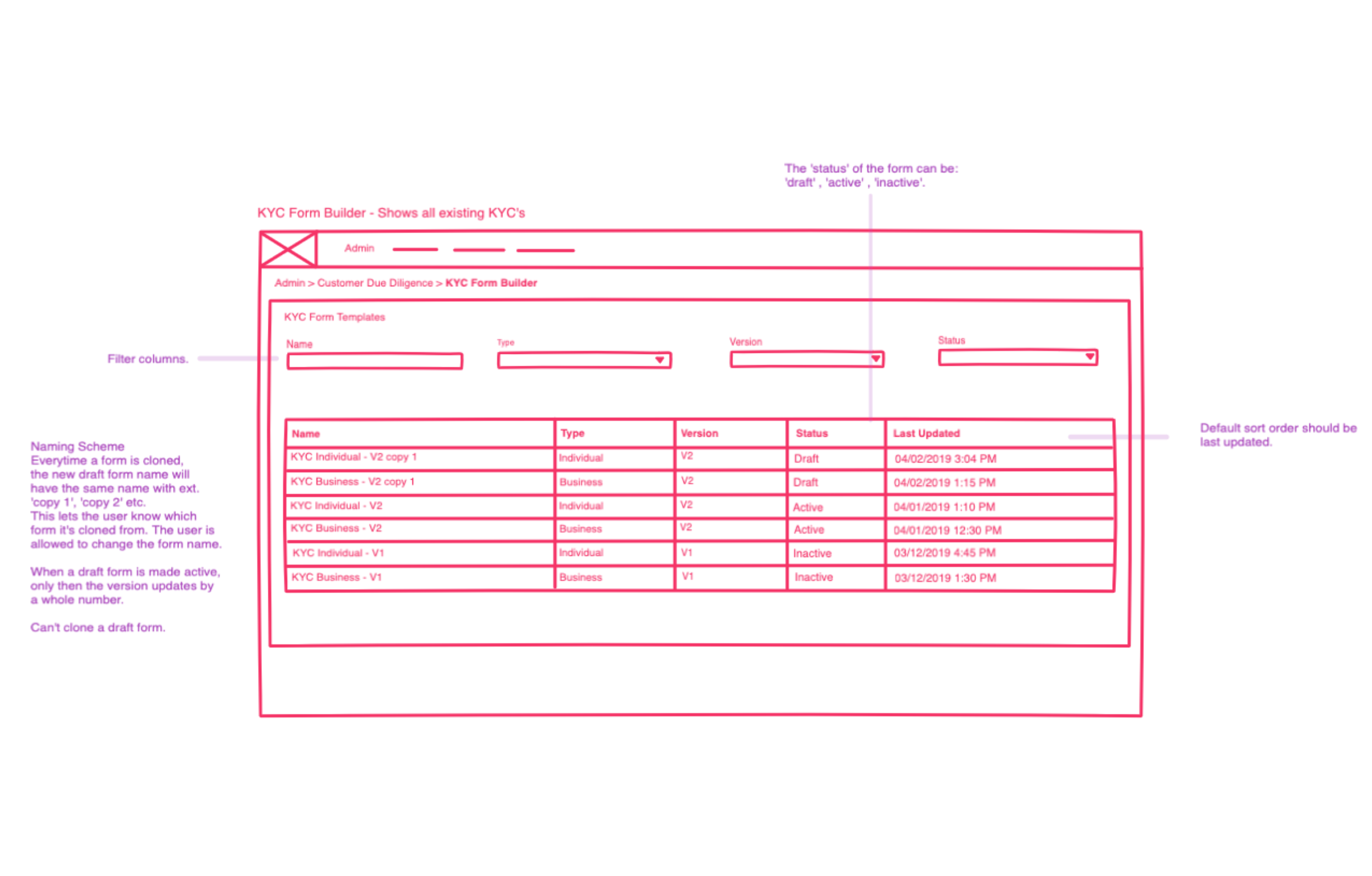
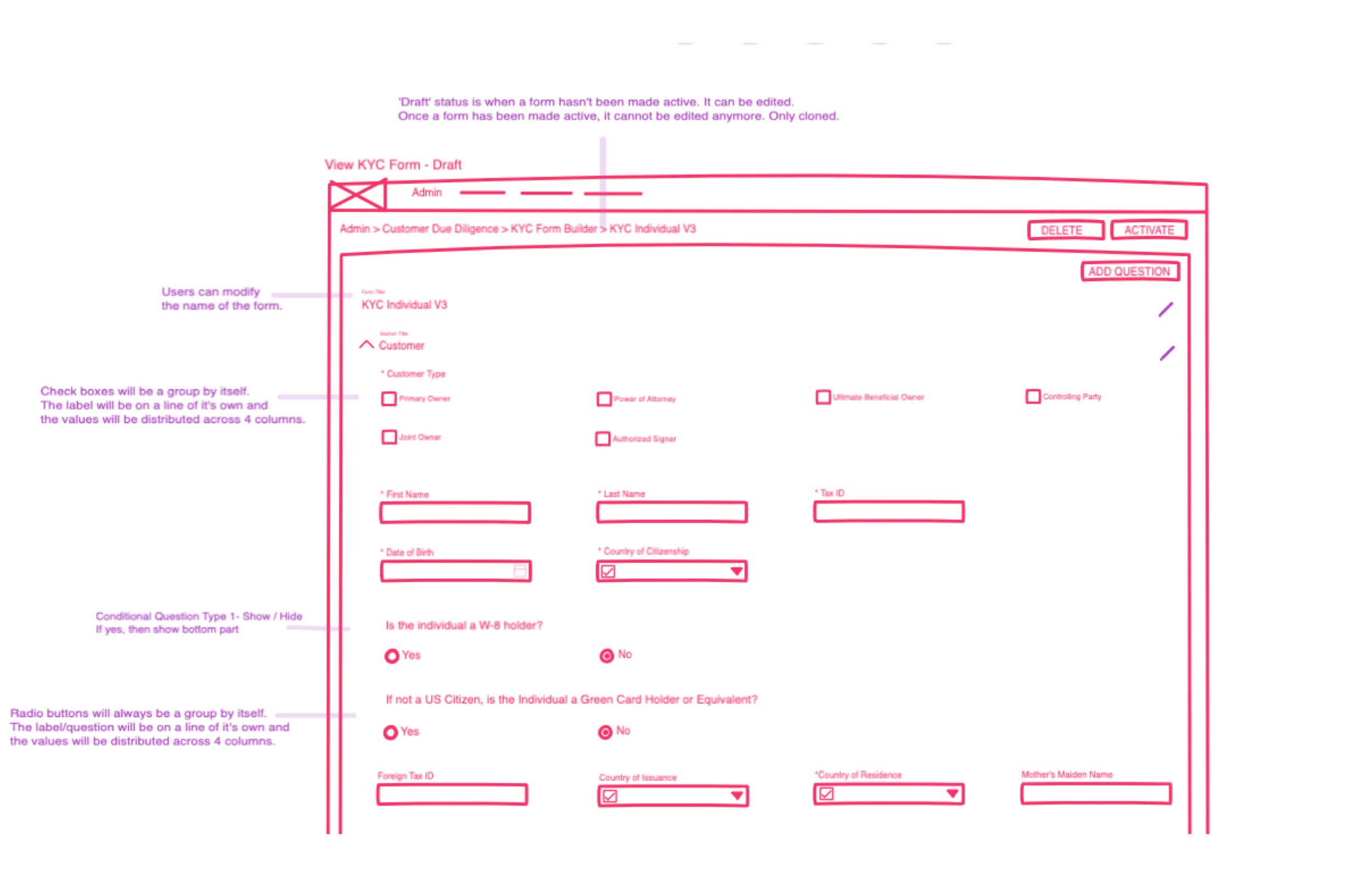
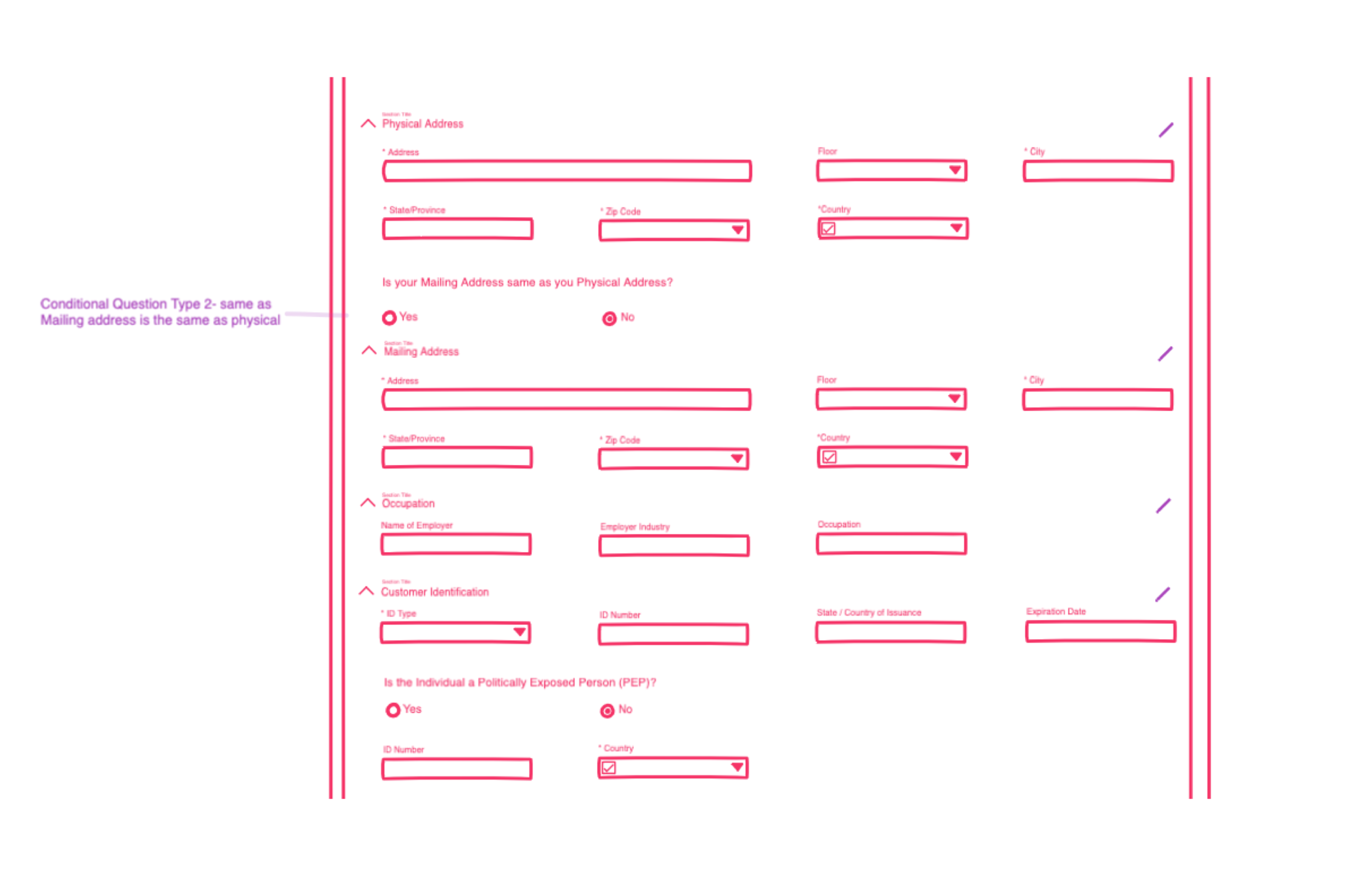
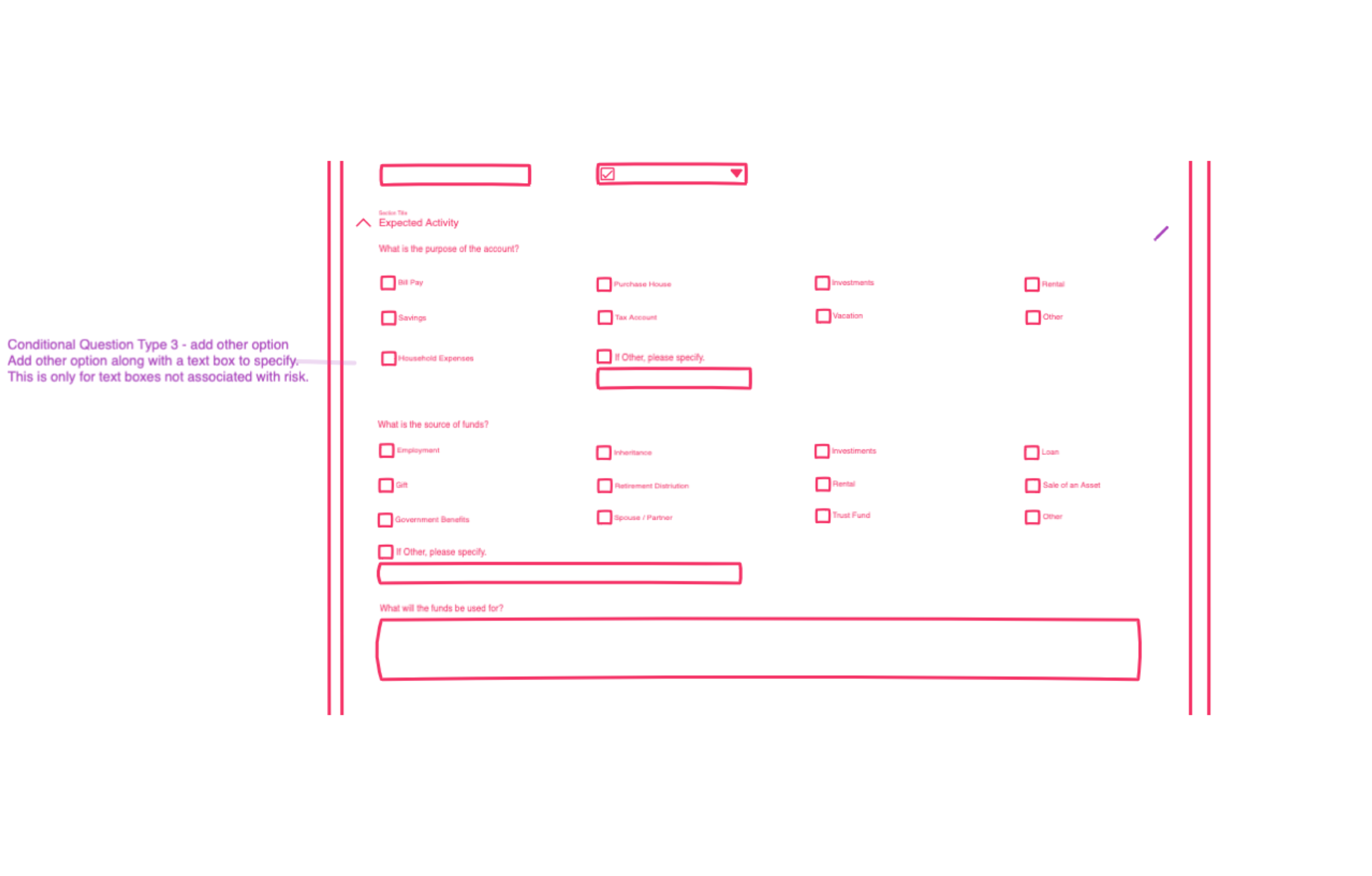
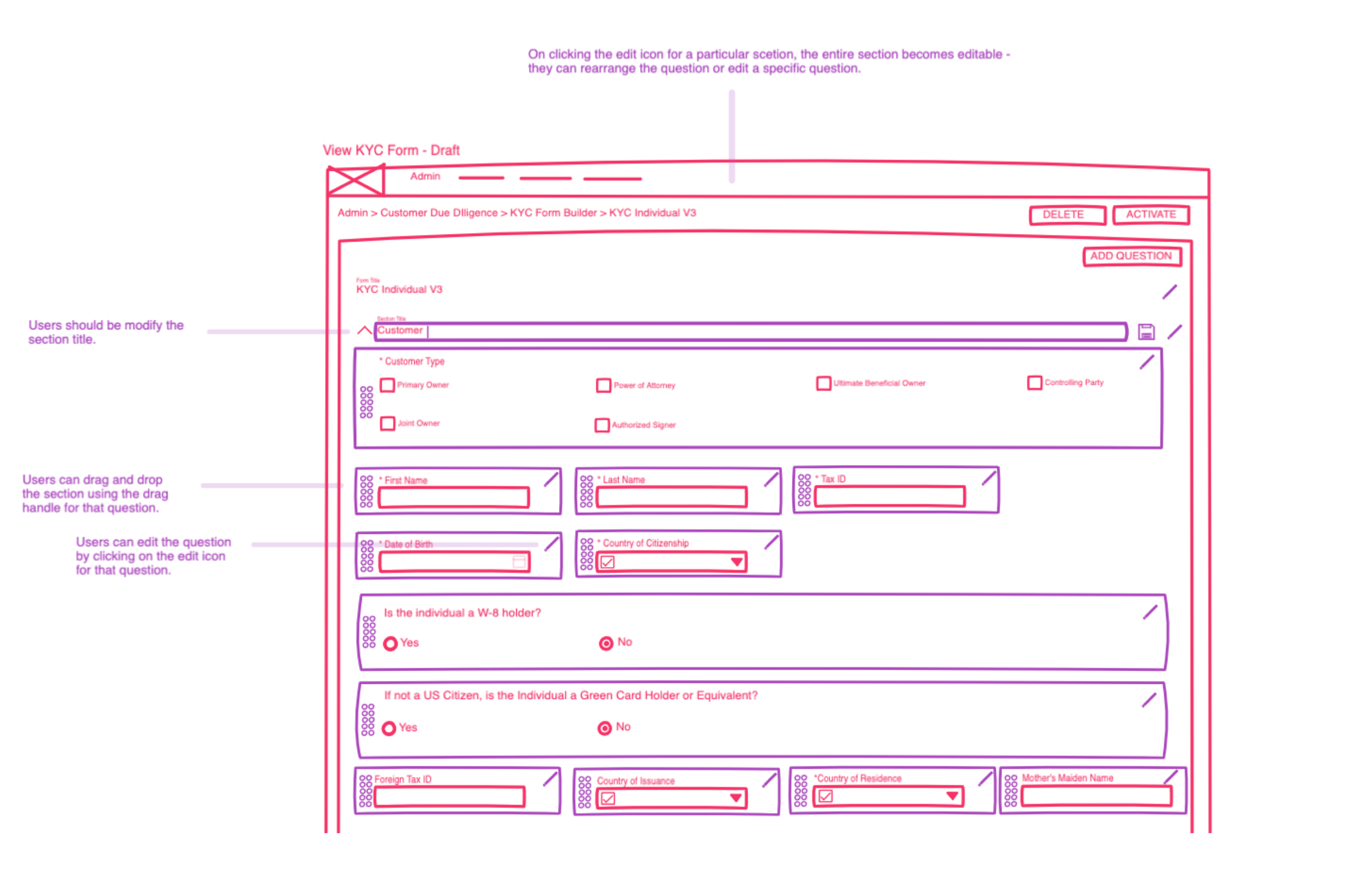
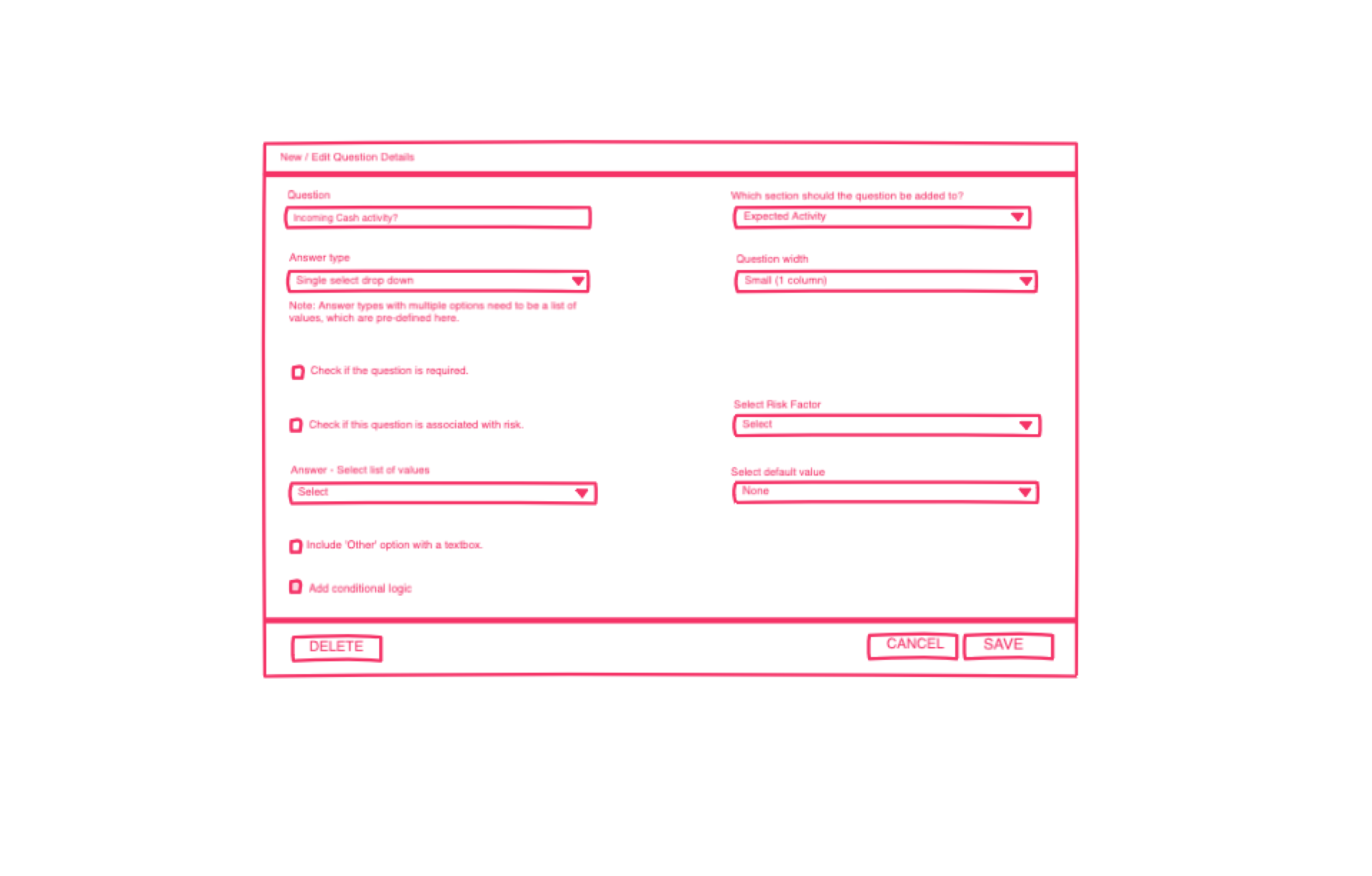
During this exercise, we decided to provide a default template with the most important questions found in a KYC form. Admins can use this as-is or build upon this, without having the set up everything on their own.
Validate
After iterating on the design and finalizing the details, I used the existing design framework to create high fidelity wireframes. These show the details in the design, and using the actual visual artifacts.
Admins maintaining the KYC form Templates
KYC Template Repository: This page is the entry point into the list of KYC templates. Users can see all the templates for each type, and their status, last updated time in one place. They can click on the specific row to open up the template and review/edit it.
KYC Form Template Details: This shows the actual template with all the questions. An active template cannot be edited, whereas draft ones can be edited. The template supports various types of questions such as text box, text area, single select drop down, multi-select drop down, checkboxes, radio buttons and conditional questions.
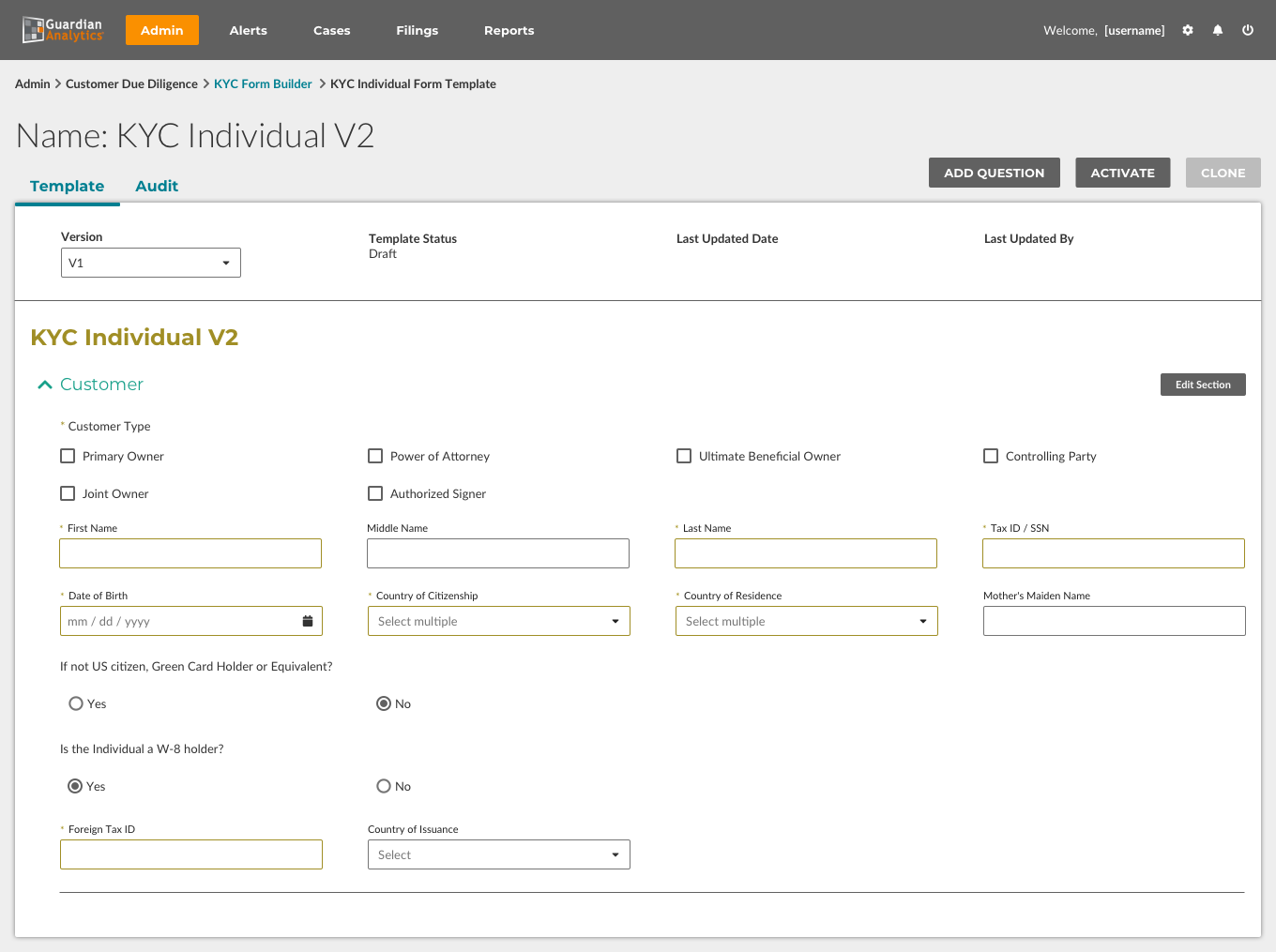
Adding / Editing questions: Admins can add different types of questions and alter the attributes for each question. This helps them admin how the risk is calculated on the answer for this question.
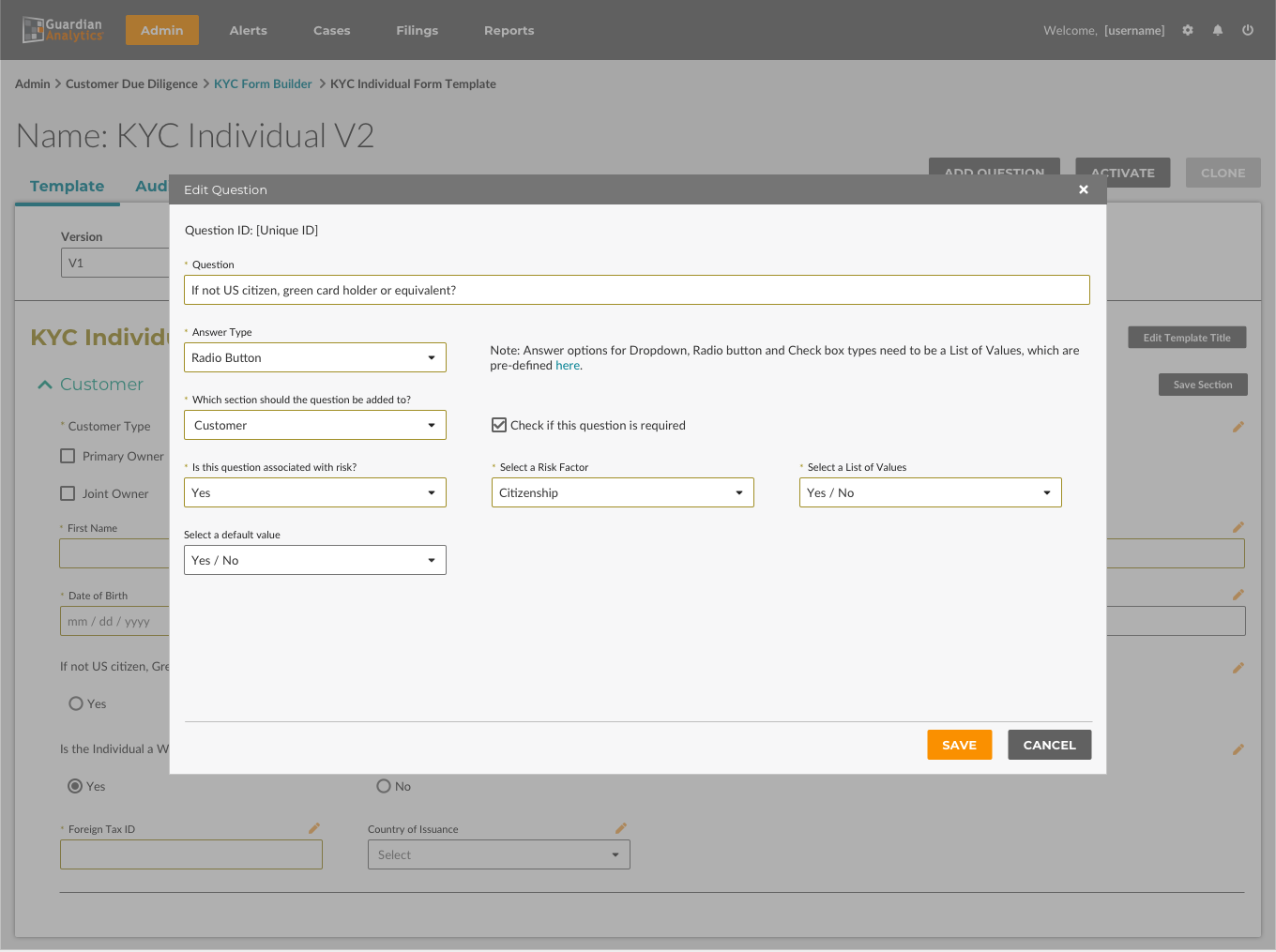
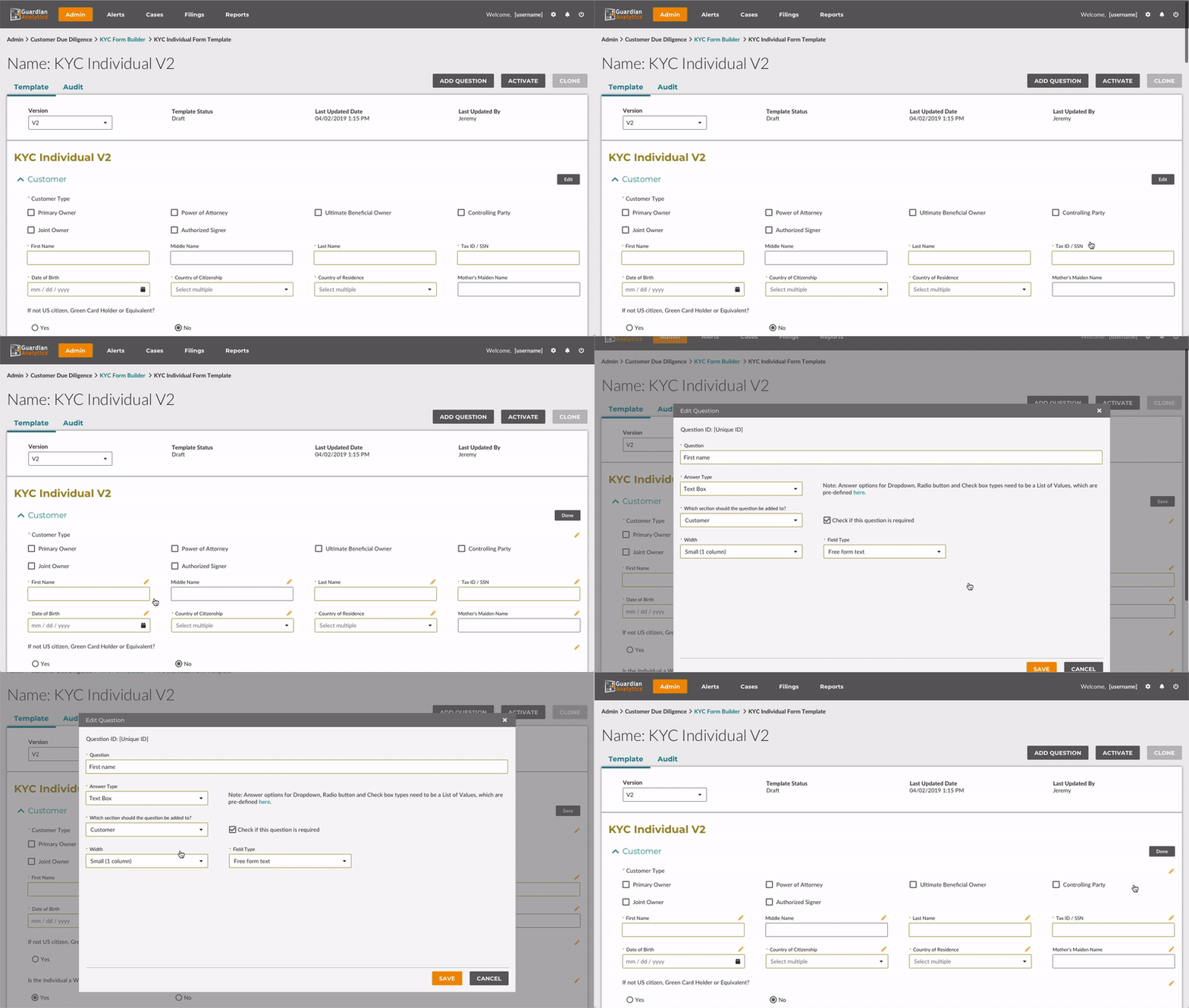
Adding / Editing a question in the KYC template
Demonstrating the process of adding or editing questions in the KYC form template.
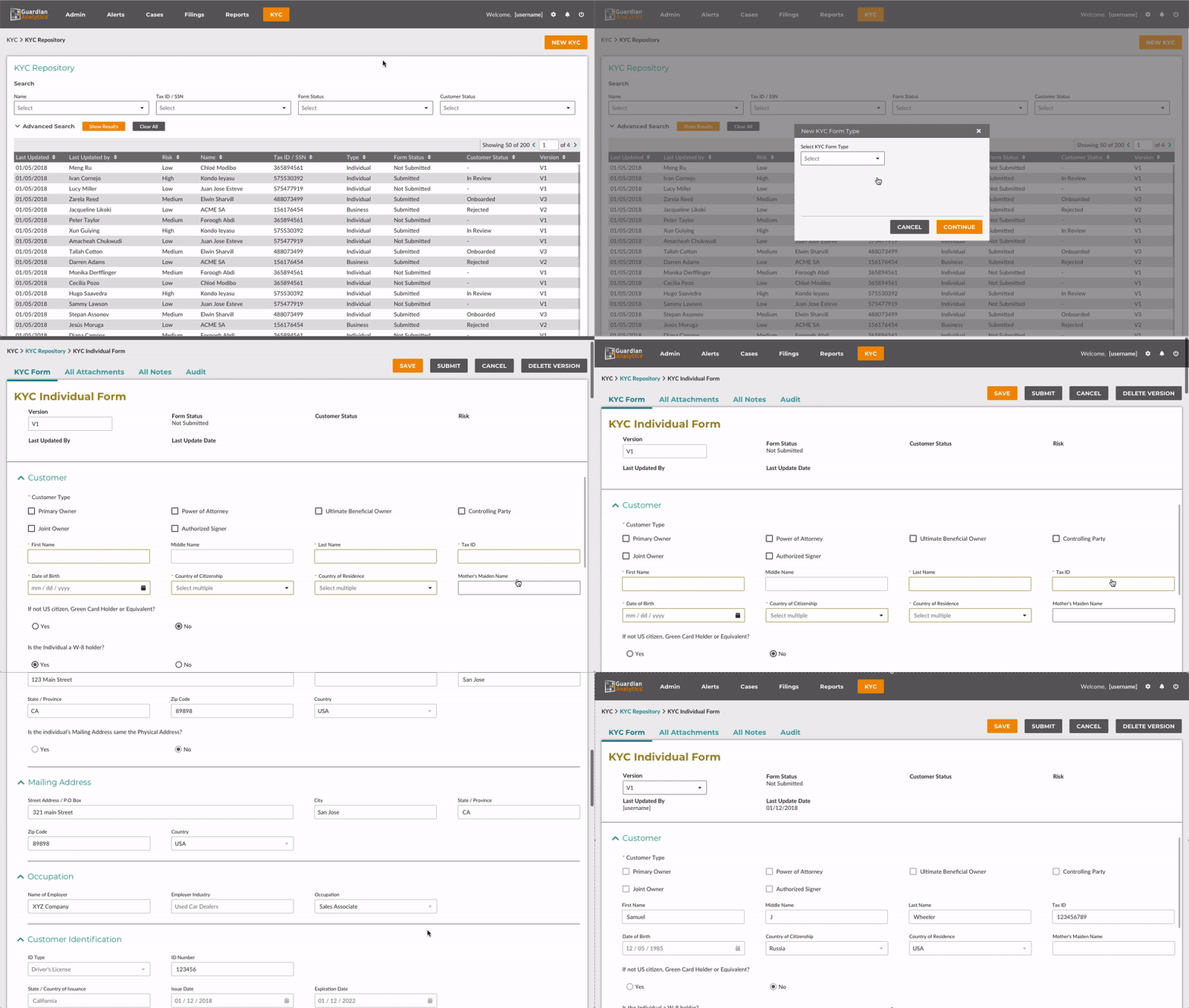
Bankers creating a KYC form using the KYC template
This process shows the creation of a KYC form for a customer, based on the customer type and KYC form template. They can easily access previous versions or create a new one.
Analysts Investigating a CDD alert
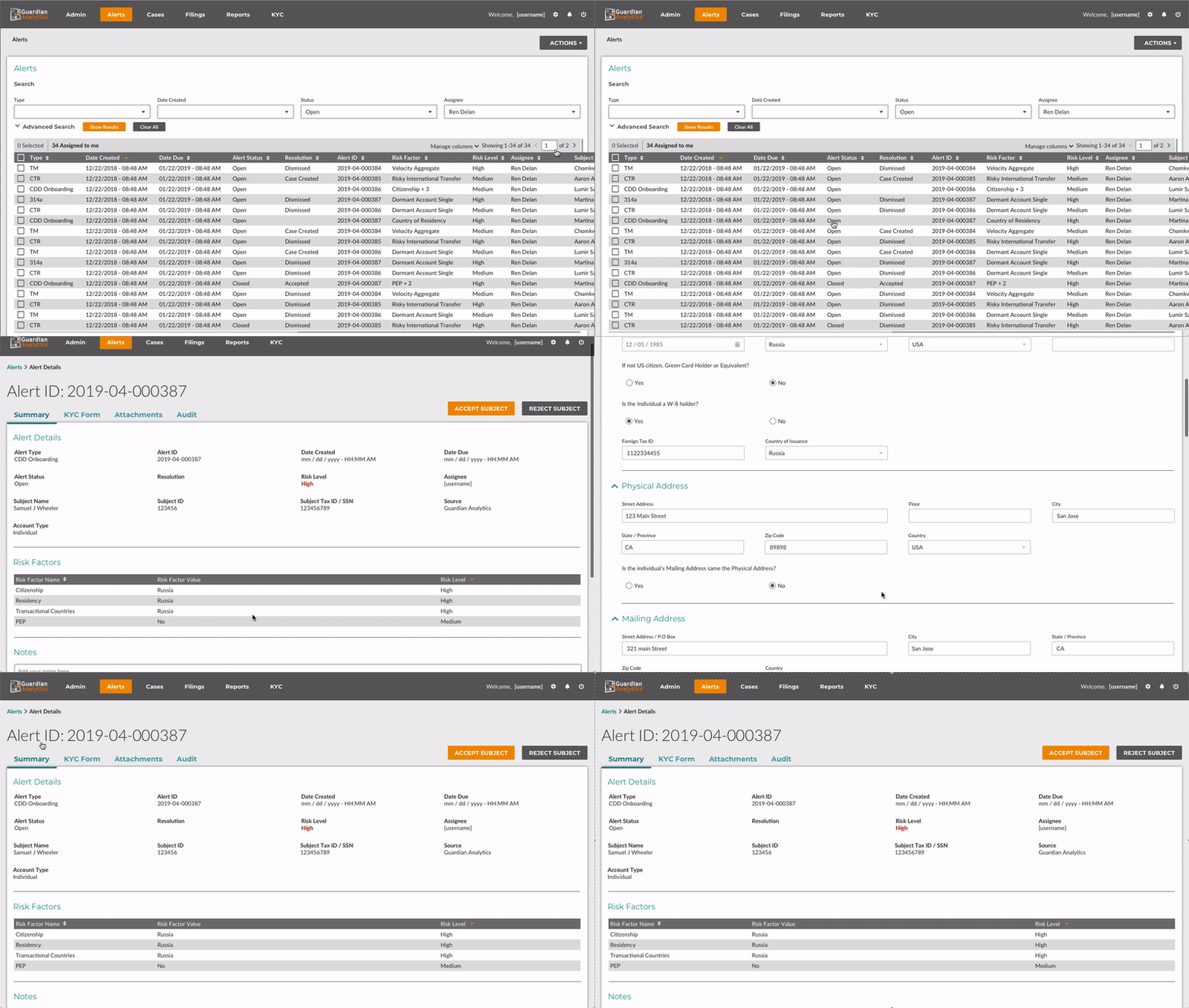
This shows a high risk alert generated for a high risk customer, based on their responses to the KYC form. The alerts show the key risk factors and the submitted KYC form, so that the analyst can efficiently review all the information in one place.
Impact and Takeaways
After a few design iterations, we were able to successfully meet the product goals.
Impact
Taking time to design the Form Builder was critical and brought in tremendous value, making it the first product to provide this level of flexibility.
User testing with prototypes helped assess usability and suggested improvements early on.
Admins can independently configure a KYC form template without having to wait on external vendors, saving time and effort.
The Banker can efficiently fill out the KYC form online, without any manual effort involving filling paper based forms, reducing time spent of this task by 60%. Based on the answers provided to these questions, a risk score for the client is computed. If the risk is low, the client is immediately on-boarded into the FI. If the risk is medium or high, a CDD on-boarding alert is generated for the analyst to review.
The Analyst can efficiently process a CDD on-boarding alert, with all the answers in the KYC form and their risk scores in one place. After sufficient investigation, they may choose to accept or decline the subject. The quality of the data provided to the analyst was improved by ~60% and the processing time of alerts was reduced by 40%.
Takeaways
It was my first time designing the interaction for long forms, which are unavoidable in some business domains.
Continuously maintaining and updating the form UI components in the design system, added value to the upcoming sprints.
User centered design outcome
Satisfied customers: Solution met customer requirements and exceeded expectations.
Unique product: Only product is the market with this level of flexibility.
Reduction in cost: Decreased customer support calls and lowered costs.